
VASP, CASP & MiCA: The Crypto Licence Terms
VASP, CASP and MiCA explained plainly — what changed in the EU, the three CASP capital classes, where 'VASP' still applies.

Contents
If you are shopping for a crypto licence in 2026, three acronyms come up on every page (VASP, CASP and MiCA), and they are used loosely enough to cause real, expensive mistakes. This guide sorts them out plainly: what each one means, what actually changed in the EU, and how to pick a jurisdiction without paying for the wrong licence.
- MiCA is the EU regulation; CASP is the licence it created; VASP is the older, pre-MiCA and non-EU term for the same kind of business.
- Inside the EU, a CASP authorisation passports across all 27 member states — one licence, the whole single market.
- CASP capital is €50,000 / €125,000 / €150,000 depending on the services you run — the tiers are the same in every EU country.
- The EU transition window for legacy national VASP registrations closed on 1 July 2026 — with no extension. Those registrations no longer authorise EU-facing services; CASP is now the only route.
- Outside the EU, “VASP” is still the correct term — offshore and Asian regimes register or license VASPs on their own rules.
What MiCA actually changed
MiCA, the EU’s Markets in Crypto-Assets Regulation, is the law. It replaced a patchwork of 27 national crypto rules with a single, EU-wide regime, and it created one licence type for firms that provide crypto services: the Crypto-Asset Service Provider (CASP) authorisation. Before MiCA, most EU states ran their own light-touch registrations, usually labelled VASP (Virtual Asset Service Provider). Those national VASP registrations were retired when the transition window closed on 1 July 2026.
The practical effect is the single biggest upgrade in crypto licensing to date: a CASP licence issued by any one EU regulator lets you serve customers in every EU/EEA country on a notification basis. You license once and passport everywhere, instead of applying country by country.
CASP, explained
A CASP authorisation is a real financial-services licence, not a registration. It requires a local company with genuine substance, fit-and-proper management, an AML officer, a DORA-compliant technology programme, and initial capital set by the service class you run:
| Class | Capital | Typical services |
|---|---|---|
| Class 1 | €50,000 | Order reception/transmission, advice, execution, placing, transfers |
| Class 2 | €125,000 | Adds custody and exchange (holding client assets) |
| Class 3 | €150,000 | Adds operating a trading platform |
Those tiers are set by MiCA, so they are identical in every EU country. That is the key insight for choosing a jurisdiction: you do not pick an EU country for cheaper capital — the capital is the same everywhere. You pick it for the regulator’s speed, the ecosystem, the tax rate and the banking.
Since MiCA harmonised capital and passporting, the licence itself is much the same everywhere in the EU, so jurisdictions compete on review speed, tax and banking. Lithuania and Estonia run roughly three to six months on a complete file; Bulgaria competes on a 10% corporate tax; Malta, Ireland and Cyprus trade on reputation.
So what is a VASP now?
“VASP” is the older, broader term — and it is still the right word in two places:
Inside the EU, VASP is legacy. It refers to the pre-MiCA national registrations, which lost their EU effect when the transition window closed. If a provider offers you an “EU VASP licence” in 2026, they mean a CASP authorisation, or a registration that has already expired — ask which, because the old one no longer authorises EU-facing services.
Outside the EU, VASP is current. Offshore and Asian jurisdictions never adopted MiCA and run their own regimes, still called VASP registration or licensing — for example Georgia (National Bank of Georgia), Seychelles, BVI and St. Vincent. These do not passport into the EU, but they are faster, cheaper and often lightly taxed.
Choosing a jurisdiction in 2026
The first decision is simple: do you need the EU market?
Get a CASP licence. Practical routes (roughly three to six months on a complete file): Lithuania and Estonia. Low cost: Bulgaria. Reputation: Malta, Ireland, Cyprus.
A non-EU VASP fits better. UAE (VARA) for the Gulf and scale, Hong Kong or Singapore for premium Asia, Georgia for low-tax speed, or an offshore VASP for the leanest setup.
Many groups run both (a CASP for the EU and a VARA or offshore VASP for the rest of the world) because no single licence covers every market. Which combination fits comes down to where your clients are: our best crypto licences by market breakdown maps each route to the job it actually does.
One practical consequence of that consolidation is that authorisation is now trivially checkable by anyone: see what the public CASP register exposes about your scope.
The deadline has now passed — and the field thinned out
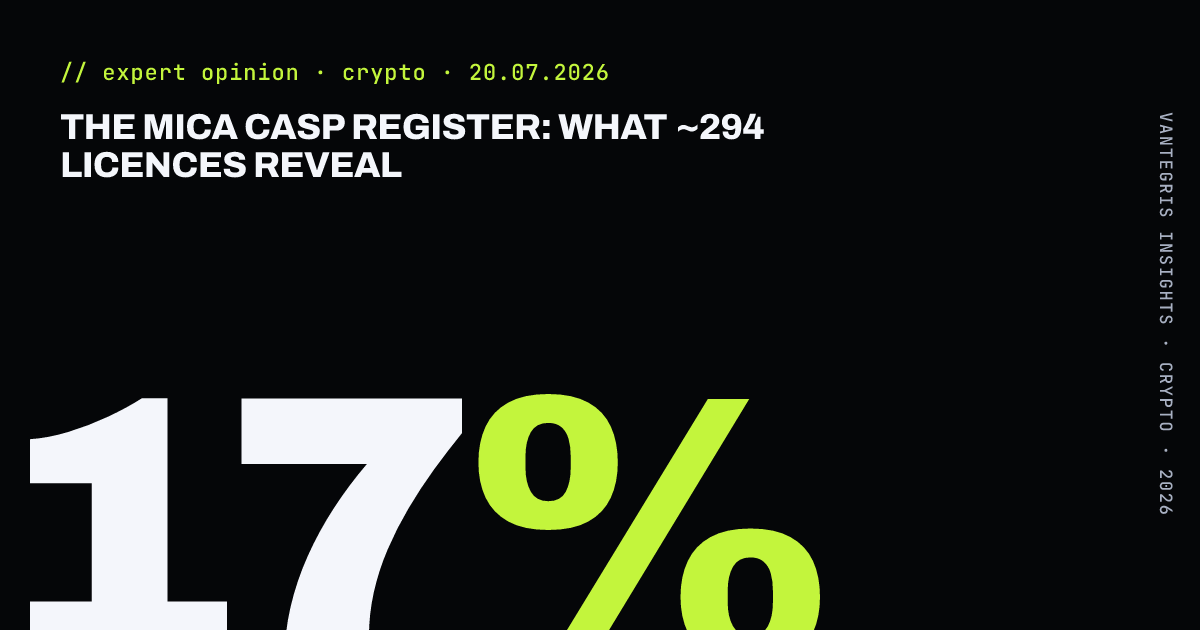
That deadline is behind us, and the shake-out was steep. As of early July 2026, only around 280 CASPs were authorised across the EU — against the 3,000-plus VASPs that held national registrations before MiCA, a conversion rate near one in six. Even large names moved late: Binance withdrew its MiCA application from Greece’s regulator on 24 June 2026, halting new EU sign-ups while it regrouped. ESMA has told unauthorised firms to wind down their EU-facing services in an orderly way, and national authorities can fine unlicensed operators up to €5 million or 5% of turnover.
The takeaway for anyone still on an old EU VASP registration is blunt: it no longer authorises anything in the EU. If Europe is your market, a CASP is the only route — file in a fast, cost-efficient member state (Lithuania or Bulgaria) and pause EU onboarding until it issues. If your users are non-EU, an offshore VASP serves them without the CASP build. We set out the post-deadline playbook in what unlicensed EU crypto firms do now, and the crypto licence cost comparison maps the field on price.
Outside the EU the picture is far less settled, and that is worth weighing before you assume a wait is safe. On the stablecoin side specifically, the US has a federal statute on the books with no final rules to build against yet. A statute alone gives you nothing to file into, whereas the MiCA regime is already operating.
Frequently asked questions
Is a VASP licence the same as a CASP licence?
In the EU, no — CASP has replaced VASP. VASP was the pre-MiCA national registration; CASP is the MiCA authorisation that passports EU-wide. Outside the EU, 'VASP' is still the current term for a crypto licence or registration under that jurisdiction's own rules.
Which EU country is cheapest for a CASP?
The capital is identical everywhere (€50k–€150k by class), so 'cheapest' comes down to state fees and tax. Bulgaria pairs a flat 10% corporate tax with FSC fees below Malta's; Estonia's distributed-profits model is attractive for reinvesting teams.
Do I need an EU licence at all?
Only if you serve EU customers. If your market is global or non-EU, a VARA (UAE), Asian or offshore VASP licence is usually faster, cheaper and sufficient. We map it to where your users actually are.
What's the hardest part of getting licensed?
Banking. Crypto-friendly banking and fiat rails are the real bottleneck in every jurisdiction, which is why we open those conversations while the licence application is still being prepared.
Sources
This article is for general informational purposes only and is not legal, tax or financial advice. Consult a qualified professional before acting.
We'll map the fastest route to a licensed, banked, live operation.
Book a free consultation →Recommended reading.

Stay ahead of the rules.
Licence fees, rules and deadlines change through the year. Subscribe and we'll email you Vantegris licensing updates.
Licence, done right.
300+ operators licensed across 40+ jurisdictions. Book a free consultation.
Book a free consultation